
If you operate a short-term rental in Michigan, “the tax rate” is not always one number.
Depending on where your property is located, how it is managed, and what happens in Lansing this year, several different taxes or assessments can potentially land on the same guest stay.
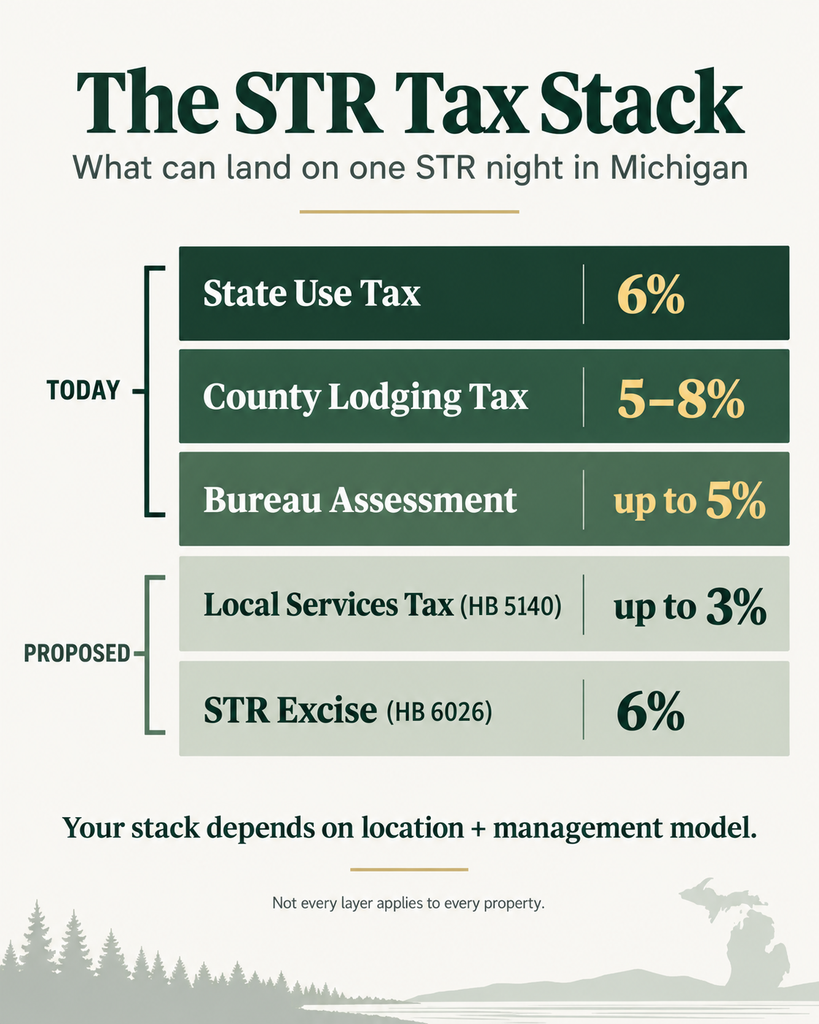
We call this the STR Tax Stack.
And with taxes playing a major role in Michigan’s current short-term rental legislation, understanding the stack matters.
Layer 1: Michigan Use Tax — 6%
Every Michigan short-term rental starts here.
The state’s 6% use tax applies to lodging statewide and is the baseline tax paid by both hotels and short-term rentals. Airbnb generally collects and remits this tax for hosts; Vrbo hosts may still be responsible for remitting it themselves depending on how the booking is handled.
For every STR: 6%.
That is the bottom layer of the stack.
Layer 2: County Lodging Tax — 5% to 8%
Some Michigan counties are authorized to impose an additional lodging tax.
These are not statewide. They apply only in qualifying counties that have adopted the tax.
For example, Kent County imposes an 8% lodging tax, while most other qualifying counties levy 5%. Many tourism-heavy counties — including much of northern and lakeshore Michigan — do not fall within the existing statute and therefore cannot currently impose this particular tax.
That means two otherwise similar STRs can already have very different tax burdens simply because of geography.
A Grand Rapids STR, for example, may currently sit at:
6% state use tax + 8% county lodging tax = 14%
while a self-managed Traverse City STR may currently owe only the 6% state tax.
Layer 3: Tourism Bureau Assessment — Up to 5%
This is where the stack gets more complicated.
Michigan tourism bureau assessments can apply to lodging facilities with 10 or more rooms. A published 2025 Court of Appeals decision clarified that scattered STR properties managed together by a manager with 10 or more qualifying rooms can be treated as one lodging facility for purposes of the assessment.
That distinction matters.
A self-managed STR may fall outside the assessment, while the same property placed with a larger professional manager may become subject to it.
For example, the presentation illustrates a Traverse City STR as:
- 6% use tax if self-managed
- 11% today if managed within a qualifying 10+ room portfolio
That same managed STR is already paying the same illustrated tax burden as a Traverse City hotel.
This is one reason MiSTRA continues to emphasize tax parity. The actual tax burden can depend not only on where the property is located, but on how the owner chooses to operate it.
Proposed Layer 4: Local Accommodations Tax — Up to 3%
One of the major proposals being considered this legislative session would allow local governments to seek voter approval for an accommodations tax of up to 3%.
Unlike some existing lodging assessments, the proposed tax is intended to support local services such as police, fire and infrastructure.
This proposal is part of the HB 5138–5140 package, which also addresses platform tax collection.
If enacted and subsequently approved locally, this would add another layer to the stack.
A self-managed Traverse City STR that currently pays 6%, for example, could move to 9%.
A Grand Rapids STR currently paying 14% could move to 17%.
Proposed Layer 5: A Separate 6% STR Excise Tax
A second legislative proposal, HB 6026, takes a very different approach.
That bill would impose an additional 6% excise tax specifically on short-term rentals, on top of the existing 6% state use tax. It is paired with a statewide STR registry, with revenue split between local governments and Pure Michigan.
This is the layer that creates the biggest parity concern.
Unlike the proposed 3% local accommodations tax, which would apply broadly to lodging, the additional 6% excise tax would single out STRs.
Under the examples used in our September legislative presentation:
- A Grand Rapids STR could rise from 14% today to as much as 23%
- A self-managed Traverse City STR could rise from 6% to as much as 15%
- A managed Traverse City STR could rise from 11% to as much as 20%
while the illustrated Traverse City hotel would reach 14% if the proposed 3% local tax applied.
That is the tax-stack issue in a nutshell.
Why MiSTRA Is Focused on the Stack
MiSTRA is not opposed to taxation simply because it is taxation.
Our members have generally recognized that tourism-dependent communities should benefit from the economic activity visitors create, and locally directed revenue can help support services and infrastructure.
But three principles matter:
Parity. Simplicity. Transparency.
Where lodging taxes apply, similarly situated lodging businesses should be treated similarly.
Owners should be able to clearly understand what they owe.
And the collection system should be simple enough that compliance does not depend on which booking platform, county, municipality or management structure an owner happens to use.
That is why platform collection reform is potentially helpful — while additional layers of taxation deserve careful scrutiny.
The Bottom Line
There is no single Michigan “STR tax rate.”
The amount attached to a guest stay can depend on:
- where the property is located,
- whether a county lodging tax applies,
- whether a tourism bureau assessment applies,
- whether the property is self-managed or professionally managed,
- and what legislation ultimately passes in Lansing.
For Michigan owners and operators, that makes the STR Tax Stack one of the most important policy issues to understand this year.
As legislation moves, MiSTRA will continue tracking not just whether new taxes are proposed, but who pays them, how they are collected, where the revenue goes, and whether the result treats short-term rentals fairly within Michigan’s broader lodging industry.
I’d also make a much simpler companion graphic than Claude’s: literally five horizontal blocks stacked vertically with only the tax name + rate inside each block, with a bracket on the left saying TODAY for the first three and PROPOSED for the last two. Then underneath: “Your stack depends on location + management model.” That would make the concept instantly understandable, while the article carries the nuance.
******
MiSTRA stands ready to work collaboratively with communities and legislators to build a framework that protects neighborhoods while honoring the fundamental rights of property owners across the state.
If you’d like to explore resources that support reasonable STR regulations in Michigan, grab our free guide “Regulating Short-Term Rentals: A Roadmap for Local Government.”