
Where good STR regulation starts
At a recent training for Michigan townships about regulating short-term rentals, much of the discussion focused on examples of regulations already being used around the state, accompanied by an important caveat: no claim was being made about whether those regulations were legal, effective, or appropriate for another community.
That distinction matters.
At MiSTRA, we regularly talk with short-term rental owners, local officials, residents, and other stakeholders. One thing we have learned is that regulating short-term rentals well is not as simple as finding another community’s ordinance and adapting it.
A regulation can be perfectly enforceable and still fail to solve the problem it was intended to address. It can also create significant administrative work for a township without producing a meaningful community benefit.
So we encourage communities to start somewhere else:
What problem are we actually trying to solve?
From there, the next questions become clearer. What rules already exist that address that problem? Are they being enforced? Is there something meaningfully different about short-term rental activity that requires an additional standard? And if so, what is the least restrictive tool that will reasonably address the demonstrated impact?
Before answering those questions, it is important to acknowledge that every regulatory framework begins with a set of assumptions. What we believe about short-term rentals, residential property, rental housing, property rights, and neighborhood impacts will inevitably shape the regulations we consider reasonable.
MiSTRA’s approach is grounded in five underlying perspectives.
1. Short-term rentals are a residential use of a home.
A family or group eating, sleeping, relaxing, and gathering in a dwelling is residential activity, regardless of whether they own the home, rent it for a year, or stay for several days.
2. Short-term rentals are a form of rental housing.
Where appropriate, communities should build on existing rental-property laws, ordinances, inspection processes, and enforcement systems rather than creating an entirely separate regulatory structure solely for short-term rentals.
3. Short-term rental owners have a responsibility to help guests be good neighbors.
Because short-term guests have less time to learn community expectations, owners should clearly communicate rules and information regarding parking, noise, trash, occupancy, local regulations, and other expectations that help guests integrate responsibly into the community.
4. Regulation should protect neighboring property rights without unnecessarily restricting the rights of property owners.
Property owners should generally be free to use their property so long as that use does not unreasonably interfere with others’ ability to enjoy their own property. Restrictions on property use should therefore address a demonstrated community impact and provide a meaningful public benefit.
Rental property owners should maintain safe, habitable housing and be reasonably responsive when issues arise. Owners or their designees should be reachable and able to ensure an appropriate response when an urgent issue occurs at the property.
We do not believe that requires the owner or designee to live within a prescribed distance. The meaningful measure is responsiveness. If a guest has a plumbing emergency, what matters is that a plumber is dispatched, not whether the owner lives ten minutes away.
5. Government should regulate demonstrated impacts, not arbitrarily restrict the underlying use of a home.
Bans, geographic exclusions, arbitrary limits on rental days, minimum-stay requirements, and similar operational restrictions can substantially limit property owners’ rights and should be supported by a clear and demonstrable public benefit.
Different standards may appropriately apply where property owners have voluntarily purchased into a community governed by private covenants, condominium documents, deed restrictions, or association bylaws that limit or operationally restrict short-term rental activity as a condition of ownership.
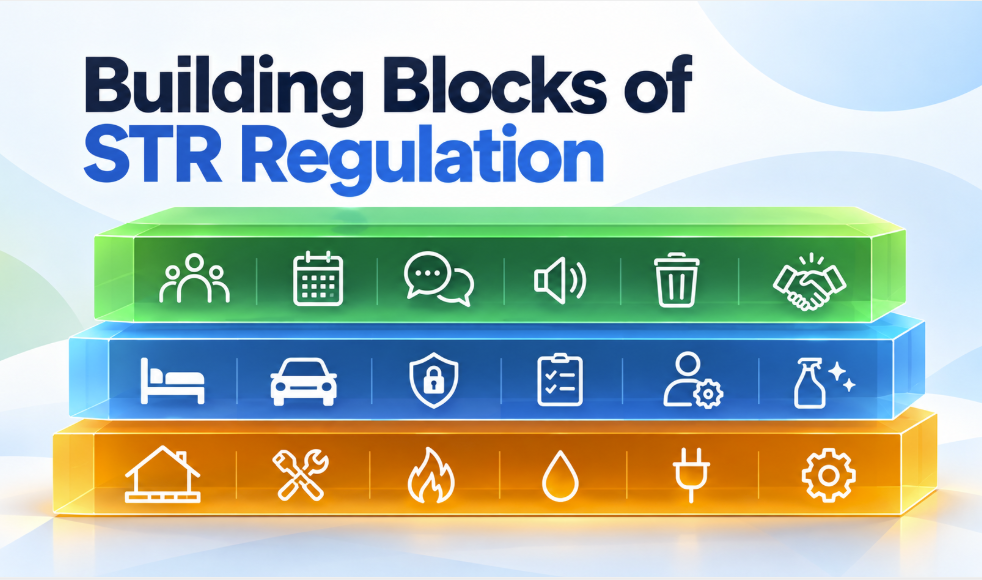
The building blocks of STR regulation
Having shared the perspectives that underlie the framework, the next step is to explain what we call the Building Blocks of STR Regulation.
The framework starts with the most basic premise: these are homes.
Foundation: safe, habitable homes and respectful neighborhoods

Every home should be safe and habitable, regardless of whether it is occupied by an owner, a long-term tenant, or a short-term guest. Communities may also need rules that protect the reasonable enjoyment of neighboring properties.
In addition to meeting residential building, health, and safety standards, communities may use generally applicable rules related to noise, parking, trash, property maintenance, and other nuisance concerns. Wherever possible, these rules should apply consistently based on the behavior or impact being addressed rather than solely on how long someone is staying in the home.
After all, a loud party at midnight? Anyone can make noise, and everyone should be subject to that ordinance.
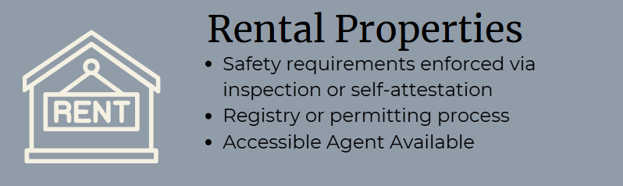
Second layer: rental property standards
Short-term rentals are also rental properties.
Communities may reasonably want assurance that rental housing meets basic health and safety standards. That may include periodic inspection or another reasonable way to demonstrate compliance. Communities may also want to know which homes are being operated as rental properties and who is responsible for them.
That may include occupancy standards designed to prevent overcrowding and a registration, permitting, or licensing process that allows the community to identify rental properties and communicate with their owners or operators.
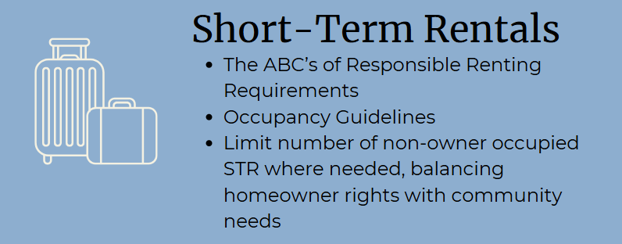
Third layer: responsibilities unique to short-term stays
Short-term stays can create different practical needs because guests have less time to become familiar with the property and the surrounding community.
For that reason, we encourage short-term rental owners to provide clear information for guests, including emergency and non-emergency contact information, wayfinding or address information for emergency responders, parking expectations, noise rules, trash procedures, and other community-specific requirements.
Resource: Download MiSTRA’s StayWise Guide for Guests template.
Communities may also identify broader impacts associated with concentrations of short-term rentals. For example, where credible data demonstrates that STR activity is materially reducing the availability of long-term housing, a community may consider narrowly tailored measures designed to address that specific impact.
The response should be proportionate to the demonstrated problem. Depending on the evidence, that may include distinguishing between owner-occupied and non-owner-occupied properties or considering carefully structured caps in markets where housing availability is demonstrably affected.
The principle is straightforward: start with the problem, then choose the least restrictive tool that reasonably addresses it.
A regulation should not begin with the assumption that a short-term rental is itself the problem. It should begin by identifying the impact the community is trying to solve.
Taken together, the building blocks are meant to help communities separate the issues that apply to all homes, the issues that apply to rental housing, and the issues that are truly unique to short-term stays. That distinction helps avoid creating an entirely separate regulatory system where existing rules may already address the concern, while still leaving room for additional requirements when there is a demonstrated STR-specific impact.
MiSTRA’s guide goes deeper, with additional background, a sample ordinance, a safety checklist, and the StayWise Guide for posting critical information for guests. [Download the guide]
Help shape what comes next
MiSTRA works with hosts, township officials, and residents across Michigan to build STR policy that is practical, fair, and based on real impacts. That work is funded by our members. Membership gives you a seat at ALAC meetings, access to First Wednesday meetups, and the resources Michigan hosts use to stay ahead of local and state policy.
Join MiSTRA today at michiganstra.org/join