
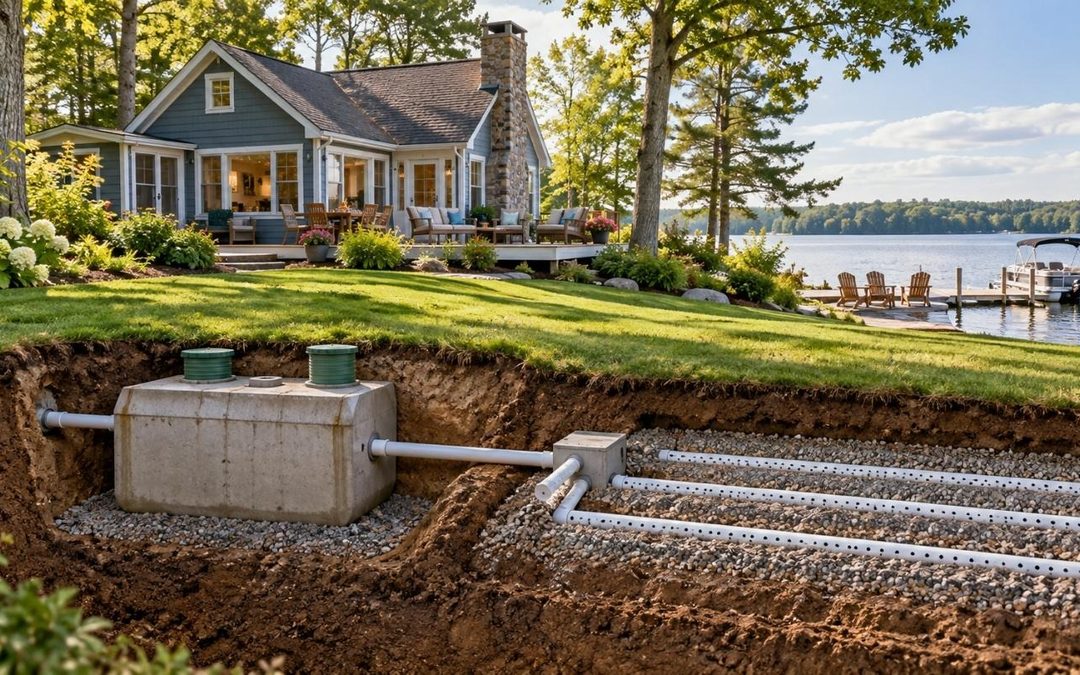
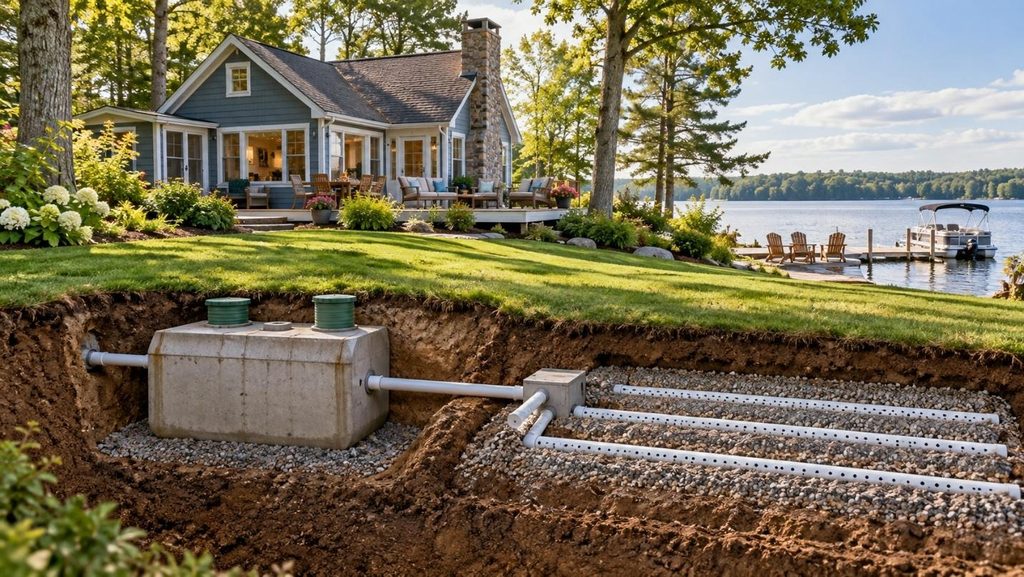
There is a fairly persistent belief in conversations about short-term rentals (STRs) which suggests that STRs are especially hard on septic systems.
In some communities, that concern has translated into requirements that every STR applicant with a septic system obtain an inspection or demonstrate septic capacity before receiving a permit, and to do that on repeat annually or on a cadence. Those requirements create costs for property owners and administrative work for the local officials responsible for reviewing, tracking, and enforcing them.
So it seems worth asking: what is the actual risk we are trying to address?
The argument usually goes something like this:
A group arrives at a vacation rental for the weekend. Everyone showers. Toilets are flushing. The dishwasher runs. Then the guests leave and the cleaner arrives and washes five or six loads of sheets and towels.
That certainly sounds like a lot of water.
But then the house may sit empty for four days. Or a week. Or two weeks.
Does that pattern of high use followed by little or no use matter to a septic system?
We’ve been digging into that question, and the answer — like most things involving land, wastewater, and regulation — is more nuanced than a simple yes or no.
What we can say confidently is that “short-term rentals inherently overwork septic systems” is much too simplistic.
Septic systems are generally designed with some breathing room
EPA guidance explains that residential septic systems are typically designed around estimated peak daily wastewater flow, and bedroom count is commonly used as a proxy for the number of people a home may ultimately accommodate.
A commonly used design assumption is approximately 150 gallons per bedroom per day — effectively allowing for two people per bedroom at roughly 75 gallons per person.
EPA also notes that actual average household wastewater flow is often substantially lower than these design assumptions, meaning conventional residential design includes some margin between expected average use and design capacity.
That makes sense.
A septic system for a three-bedroom house cannot reasonably be designed only around the retired couple living there today. Someone else may buy the house next year and move in with three children.
The house remains a three-bedroom house; the occupancy will shift.
That is one reason we should be cautious about assuming that a functioning residential septic system suddenly becomes inadequate simply because the home begins being rented for short stays.
Annual use and peak use are not the same thing
This is often the crux of the conversation: “The home sits vacant for half the year” vs “The home has 14 people taking showers all weekend”.
AirDNA data representing more than 34,000 short-term rental listings across Michigan, tells us the listing-weighted average occupancy rate over the past year is approximately 53%. (Fall 2025 – Fall 2026)
In other words, the average STR in Michigan is rented a little more than half the year.
Many of those properties are also second homes, so owners and their families may occupy them during additional periods. Still, that is a very different use pattern than assuming a house is continuously occupied at its maximum STR capacity 365 days a year.
Consider two real examples.
A three-bedroom East Tawas property operates at roughly 38% rental occupancy, with an average of five guests when occupied – and a max capacity of 7.
Five guests in the house on a Saturday certainly produce wastewater. But annualized, that is nowhere close to five people living in the house every day of the year.
Now consider a four-bedroom South Haven property with a maximum occupancy of 12. It operates at just under 50% annual rental occupancy, with an average party size closer to eight.
That property may experience considerably heavier wastewater use on a fully occupied summer weekend.
But again, it also spends a significant part of the year without paying guests in the home.
Neither example proves that the septic system can safely accommodate any number of people.
What they illustrate is that annual hydraulic load and peak hydraulic load are different things.
A long-term rental occupied by five people may use its septic system every single day.
An STR may have eight people using the system heavily on Saturday and Sunday and then nobody using it Monday through Thursday.
Those patterns create different stresses.
Neither is automatically worse.
Where the concern becomes legitimate
There are absolutely situations where STR use should raise a septic-capacity question.
Suppose Grandma’s three-bedroom cottage has an older septic system and the next generation decides to advertise the property as sleeping 14 people.
Someone should probably ask some questions.
That isn’t anti-STR.
It is a reasonable wastewater-capacity question.
But now flip the example.
Grandma bought the cottage in 1965. Her family spent summers there for decades. Nobody knows much about the septic system because the original paperwork is long gone. The house has no history of sewage backing up, surfacing in the yard, or creating another obvious health or environmental concern.
Eventually, the family begins renting the cottage for part of the summer to help cover the taxes, insurance, and maintenance.
Did listing the cottage on Airbnb suddenly make the septic system unsafe?
Of course not.
And that is where the regulatory conversation needs more nuance.
The STR-specific issue may be the surge
There is one characteristic of short-term rental use that probably deserves more attention: concentrated water use.
EPA recommends that septic-system owners spread water use throughout the week and specifically cautions against doing all household laundry in a single day.
Now consider a typical vacation-rental turnover.
Guests spend the weekend at the house and Sunday morning brings showers for everyone. Add in the toilets are being used. Breakfast happens and the dishwasher runs as everyone checks out.
The cleaner arrives and starts washing sheets, towels, bath mats, and kitchen linens.
Five or six laundry loads immediately following a high-use weekend may be a more meaningful septic concern than whether that home was rented 40%, 50%, or 60% of the year.
But there is another side to that equation.
If nobody occupies the house for the next five days, wastewater is no longer continuously entering the system. The tank, drainfield, and surrounding soil have time without additional household loading.
That doesn’t mean every septic system simply “resets.” Soil conditions, system age, groundwater, maintenance, drainfield condition, and system design all matter.
But it does mean that a vacation rental’s use pattern can be very different from a fully occupied home producing wastewater every day.
That deserves to be part of the conversation too.
What are we actually trying to prevent?
Ultimately, the concern with septic systems is fairly straightforward.
We don’t want a system to fail in a way that causes sewage to back up into the home or surface on the property.
And, more importantly from a public-health perspective, we don’t want inadequately treated wastewater reaching groundwater, drinking-water wells, lakes, streams, or other surface waters.
Those are real risks.
But a failed septic system is also a significant problem for the property owner.
A home with sewage backing up into the bathrooms or wastewater surfacing in the yard is not particularly viable as a short-term rental. Reservations may need to be canceled. Guests cannot reasonably be housed there. Repairs become unavoidable.
That doesn’t mean regulation has no role, but it does point to a high incentive to maintain the system regardless of regulations.
It also means communities should weigh the likelihood and consequences of the risk against the administrative burden of trying to prevent it.
Inspection may not always be the best first tool
There are situations where additional review makes sense.
If a three-bedroom house is advertised to sleep 14 people, it is reasonable to ask whether the wastewater system can support that occupancy.
If bedrooms have been added, the home has been substantially expanded, there is evidence of septic failure, or an owner is seeking occupancy significantly above documented septic capacity, further review may be warranted.
But requiring every STR with a septic system to undergo a new inspection simply because it is rented for short stays is a different proposition.
That requirement costs owners and townships time, money, resources.
It requires administrative systems to receive and review records.
It can become particularly complicated for older Michigan cottages where original septic permits may be incomplete, unavailable, or nonexistent.
And before imposing that burden, communities should ask an important question:
Is there evidence that short-term rental use is causing septic failures at a rate that justifies the requirement?
We have not found evidence demonstrating that STRs as a category experience septic failure at higher rates than owner-occupied homes or long-term rentals.
That doesn’t prove the risk doesn’t exist.
It means we should be careful about designing regulation around an assumption rather than a demonstrated problem.
Some of the best solutions may not be regulatory at all
If concentrated water use is the more meaningful STR-specific concern, owner education may be surprisingly valuable. Even within MiSTRA’s highly engaged membership – not all were versed in the EPA’s recommendations to spread out water usage.
STR owners on septic can reduce peak loading by using high-efficiency washing machines and dishwashers, avoiding unnecessary same-day laundry loads, properly maintaining and pumping their systems, and setting occupancy that reasonably reflects the home’s wastewater capacity.
Property managers and cleaners may also need to think differently about turnovers on septic properties.
Six loads of laundry immediately after ten guests shower may not be the best operating practice when some of that laundry could be handled offsite or spread over a longer period.
Those are relatively simple operational changes.
And unlike a blanket inspection requirement, they directly address the behavior creating the potential risk.
The better question
There is a legitimate conversation to have about septic systems and short-term rentals.
But instead of asking:
Do short-term rentals overwork septic systems?
We might ask:
What is this system designed to handle, how is it being used, and is there evidence that its use is creating a health or environmental risk?
The answer may lead to an inspection, a lower occupancy limit, or just changing turnover practices.
And sometimes Grandma’s old cottage — rented for eight summer weekends a year — may be functioning just fine.
Good regulation should be able to tell the difference.
And before adding another inspection, certification, or permitting requirement, communities should make sure the administrative burden is proportionate to the problem they are actually trying to solve.
Grab the guide